Chemical Purity Standards 2026: Lab Grade Guide
Ever wonder why one bottle of ethanol costs double another? It isn’t just the brand. It’s what’s inside, or rather, what isn’t. If you’re running a lab in the UAE, picking the wrong grade can ruin a year of research. Or worse, it can wreck a million-dirham HPLC machine. Navigating chemical purity standards 2026 isn’t about memorizing charts. It’s about knowing exactly how much “dirt” your specific application can handle.
At Saffron Chemicals, we see it daily: scientists overspending on purity they don’t need, or cutting corners where it matters most. Let’s fix that.
What Is the Difference Between AR and ACS Grades?
The short answer? ACS is the gold standard for high-level analysis. AR (Analytical Reagent) is its close cousin. ACS stands for American Chemical Society. If a bottle has this label, it meets or exceeds the strict purity specs set by the ACS Committee on Analytical Reagents.
AR grade is generally high purity and suitable for most analytical work. However, if your protocol specifically demands ACS, don’t swap it for standard AR. In UAE labs, ACS is usually the go-to for complex titrations and sensitive environmental testing where even a part-per-million deviation creates a headache.
Why HPLC Grade Chemicals Are Non-Negotiable
If you’re using high-performance liquid chromatography, purity isn’t a luxury. It’s a requirement. HPLC-grade chemicals undergo extra filtration and purification to remove trace organics that could cause “ghost peaks” on your chromatogram.
Imagine spending weeks preparing samples only for your results to look like a mountain range of errors. That’s what happens with sub-par solvents. These chemicals are also cleared for “UV transparency.” This means the solvent won’t absorb light and interfere with your detector.
The Breakdown: Which Grade Fits Your Lab?
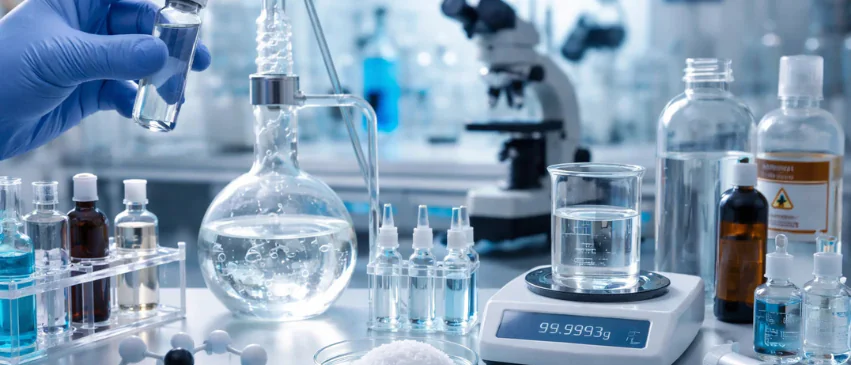
Not every task needs the highest purity. Here is the “Real Talk” hierarchy:
- Technical/Commercial Grade: Good for cleaning or large-scale industrial work. Don’t let this near your analytical equipment.
- Laboratory Grade: The “workhorse” grade. Great for educational demos or general lab tasks, but its impurities aren’t precisely mapped.
- AR/ACS Grade: Necessary for quality control and research. These come with a Certificate of Analysis (CoA), so you know exactly what’s in the jar.
- HPLC/GC Grade: The peak. Used for instrumental analysis where trace-level detection is the goal.
Avoiding the "Dubai Dust" Problem: Storage Matters
In the UAE climate, even the best chemical purity standards 2026 won’t save you if your storage is off. Heat and humidity are the enemies of reagent stability. Saffron Chemicals ensures that every batch is stored and transported under climate-controlled conditions to prevent degradation before it reaches your bench.
Final Thoughts on Chemical Purity Standards 2026
Choosing the right grade is a balance between your budget and your data’s integrity. Are you over-specifying and burning through your grant? Or are you risking a “redo” by using basic lab-grade reagents for sensitive work?
What’s the biggest challenge you’ve faced with reagent contamination lately?
FAQ
Look, you can, but you shouldn’t. AR grade might be 99% pure, but it’s that 1% of unknown gunk that clogs your columns and creates background noise. It’s like putting low-grade fuel in a supercar. Don’t do it.
Usually, yes. ACS requires more rigorous testing and documentation. You’re paying for the peace of mind that comes with a verified standard. If your work is being published or audited, go to ACS.
Focus on the “Assay” percentage and the “Impurities” list. If you see a high level of a specific metal that interferes with your reaction, skip that batch. A good supplier should always provide this doc on request.
Nope. Once you pop the seal, the clock starts. Some chemicals are hygroscopic—they suck moisture right out of the Dubai air. Keep those lids tight.