
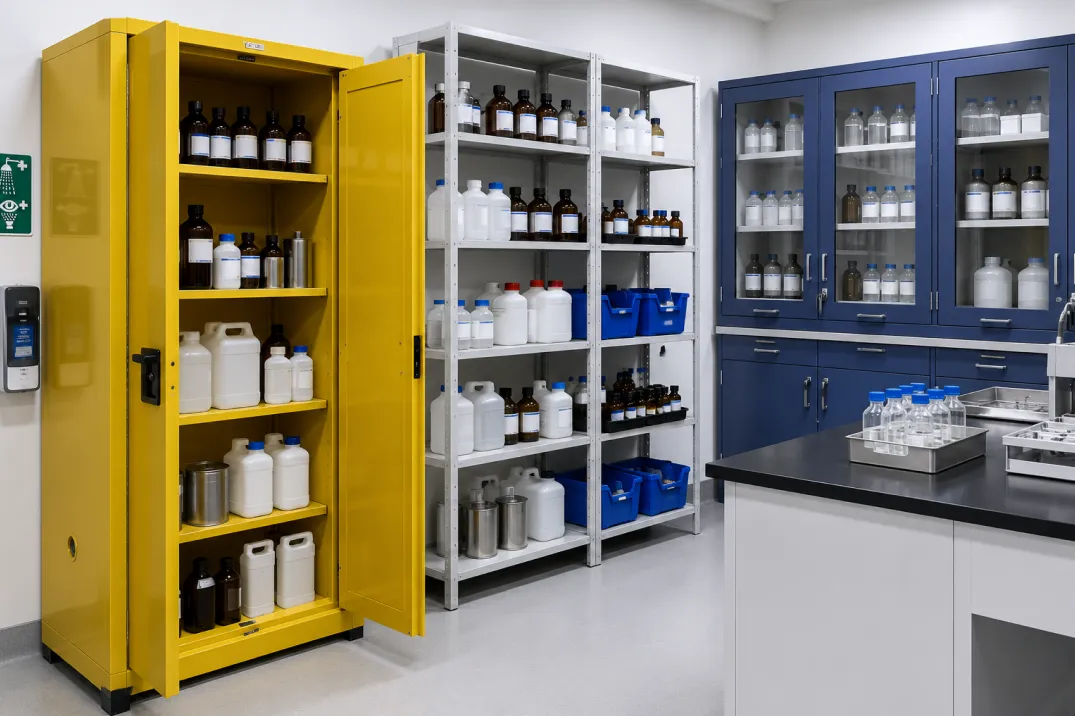
Laboratory Chemicals Storage UAE: 7 Degradation Signs to Know
A lab in Dubai Investments Park ran the same iron assay three times in one week and got three different results. Same analyst. Same method. The instrument got recalibrated twice before anyone checked the phenanthroline reagent. It had been sitting next to a window with direct afternoon sun. The solution had faded from its reference orange-red to something closer to straw yellow. Three days of repeat work traced back to one poorly stored reagent. This happens more than labs report. Laboratory chemicals storage UAE conditions are genuinely different from the 15 to 25°C baseline that most shelf life data assumes.
When storage areas hit 38°C or higher during summer, reagent chemistry changes faster than the expiry date reflects. Here are seven things to check before trusting a reagent on a real sample run.
Table of Contents
7 Signs Your Laboratory Chemicals Storage UAE Have Degraded
Sign 1: Colour Shift from the Reference Appearance
Every reagent has a documented reference appearance. Potassium permanganate should be deep purple. If it has gone brown, or a clear organic reagent has turned yellow at the bottle edges, oxidation has started. Check it against your method’s acceptance criteria before using it on real samples.
Sign 2: Cloudiness in a Solution that was Clear
A solution that was optically clear and is now hazy has changed physically or chemically. In UAE lab chemical storage, hygroscopic salts absorbing moisture through a poorly sealed cap are frequent causes. Whatever the reason, the product is no longer what was originally prepared.
Sign 3: pH Drift in Certified Buffer Standards
A sealed pH 7.00 buffer stored correctly should read within 0.02 pH units on a calibrated meter. If it reads 7.08 or 6.93, the buffer has changed. CO₂ absorption through loose seals is the most common cause, and it accelerates in labs where refrigerator doors get opened repeatedly in a warm room. Before recalibrating the meter, check the buffer.
Sign 4: An Odor that Does Not Match What You Remember
Solvents and organic reagents change smell as they decompose. Acetic acid smelling sharper than usual suggests evaporative loss. Any organic solvent carrying a secondary odor it did not have when first opened should be flagged before use. Catching this comes from regular handling familiarity, which is why experienced bench analysts spot it faster than a quarterly audit.
Sign 5: Phase Separation that Does Not Clear After Mixing
Pre-formulated staining solutions sometimes separate on standing. Gentle inversion usually fixes it. When separation persists after mixing or returns within minutes, the formulation has broken down. Gram stain reagents stored through UAE summer temperature swings are a common example.
Sign 6: Expiry Date that Assumed Conditions You Did Not Provide
The date on the label assumes manufacturer-recommended storage throughout the product’s entire life. Transport in UAE summer without validated cold packs, a warehouse that only cools during working hours, or a single overnight refrigerator failure can each shorten the effective window significantly. Without a temperature log, that expiry date is an optimistic estimate.
Sign 7: Results that Are Off with No Instrument Explanation
Calibration curves are drifting. Control samples outside expected ranges. Duplicates disagreeing past your method’s precision limits. When these appear together and instrument diagnostics come back clean, the preparation chemistry is the next variable to investigate. Systematic bias across multiple samples on the same batch points to a reagent problem, not random error.
What to Do Once You Find a Problem
Stop using the suspect reagent for quality-critical work. Prepare a fresh batch from properly stored, in-date stock and re-run the affected samples.
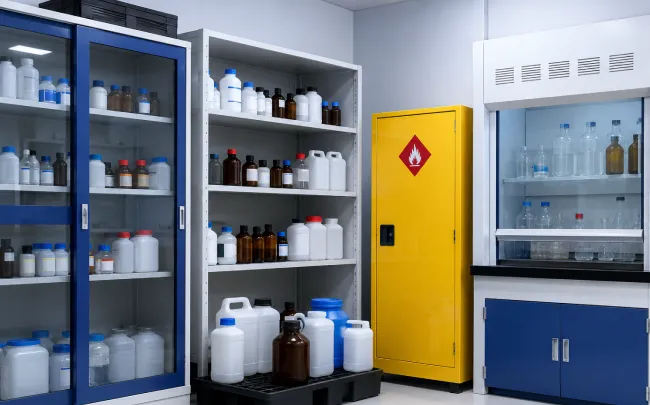
Then look at the storage environment itself. The most consistent causes in UAE labs are reagent cabinets near south- or west-facing windows, refrigerators that temperature-cycle from frequent opening, and storage areas where air conditioning switches off overnight or on weekends.
Saffron Chemicals supplies laboratory chemicals storage UAE, including analytical reagents at AR and ACS grades, dry solvents, and reference-grade materials for quality control and research facilities. Their range covers purity grades suited to different accuracy requirements across UAE-based labs.
Final Thoughts
Most reagent problems in UAE labs are storage problems. The expiry date on a bottle is a ceiling, not a guarantee. Temperature logs, cabinet placement, and properly sealed containers are what determine whether that ceiling holds.
When did your lab last check open reagents against their actual storage conditions rather than just the label date?
FAQ
Heat speeds up oxidation, hydrolysis, and decomposition. A reagent stored at 35°C degrades measurably faster than one at 20°C. Manufacturers write shelf life for recommended conditions. Outside that range, the clock runs faster than the label says.
Enzyme-based reagents, biological buffers, antibiotic reference standards, and peroxide-forming solvents like THF and diethyl ether. Peroxide accumulation in stored solvents is a safety hazard, not just an accuracy problem.
Most general analytical reagents stay stable between 15 and 25°C, away from light and moisture. Biochemical reagents typically need 2 to 8°C. If the right conditions cannot be consistently maintained, treat the reagent as unreliable regardless of the date on the label.
Monthly visual checks are a practical baseline. Any reagent showing colour change, unusual odor, or cloudiness should be reviewed immediately, not held until the next scheduled audit.