
Chemical Safety Data Sheets: Know Before You Handle
Someone in a warehouse in Sharjah opens a container of sulphuric acid. No label check, no paperwork, no protective gear beyond rubber gloves. Two minutes later, there’s an emergency. This does not always happen because people are careless. It happens because a critical document, the one sitting in a folder somewhere, never actually got read. Chemical safety data sheets exist to prevent exactly that moment. From analytical reagents and laboratory chemicals to industrial solvents, every hazardous substance that enters a facility should come with one.
But they only work when people understand what they are, how to read them, and why skipping them is never a small risk.
What Are Chemical Safety Data Sheets Actually?
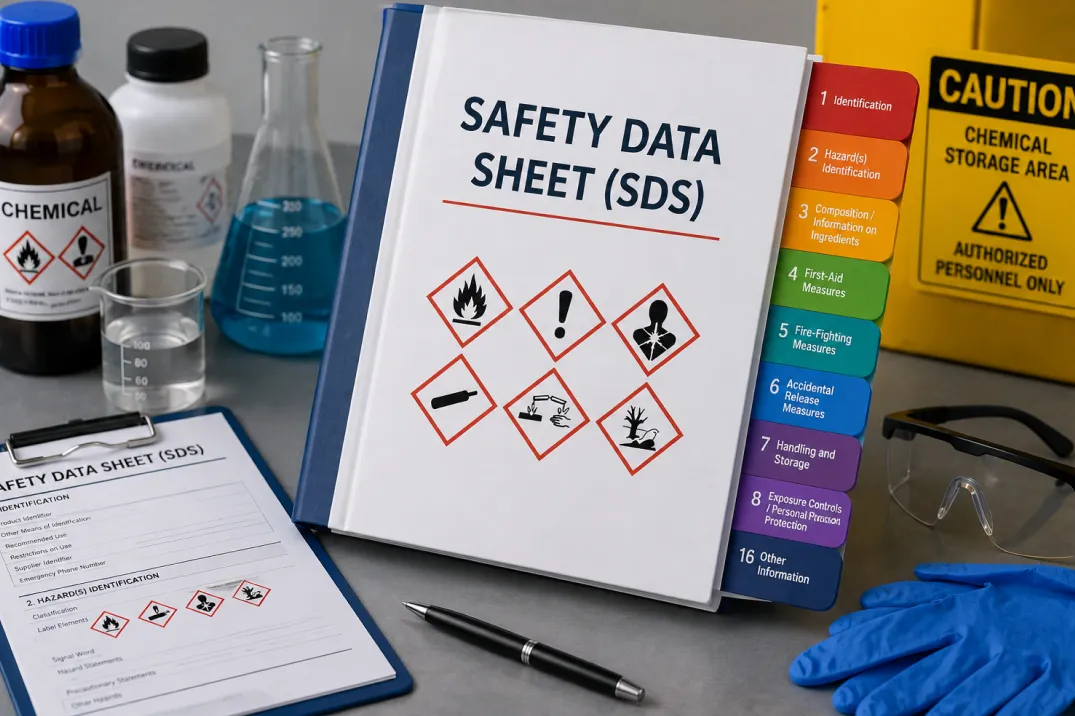
Chemical safety data sheets, often abbreviated as SDS, are standardized documents that travel with every hazardous substance. They describe what a chemical is, what hazards it poses to human health and the environment, how to handle and store it correctly, and what to do when something goes wrong.
Older documentation used the term MSDS, which stood for Material Safety Data Sheet. That terminology has largely been replaced following the global adoption of the Globally Harmonized System of Classification and Labelling of Chemicals, or GHS. Under GHS, the format became standardized across countries, meaning a facility in the UAE working with internationally sourced chemicals can now expect a consistent structure regardless of origin.
Globally Harmonized System of Classification and Labelling of Chemicals
The layout is deliberate. Emergency-critical information comes first. Regulatory and technical detail follows.
Sections 1 to 4: The Urgent Stuff
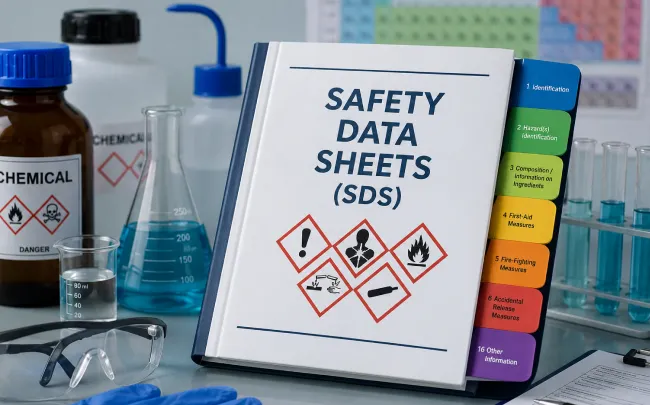
Section 1 names the product and supplier. Section 2 is hazard classification, signal words, and GHS pictograms. Section 3 lists chemical composition above threshold limits. Section 4 is first aid, broken down by exposure route: skin, eyes, inhalation, ingestion. In an emergency, Section 4 is one of the first parts of the SDS responders should review.
Sections 5 to 8: When Something Goes Wrong
Section 5 covers firefighting, including which extinguishing agents make things worse. Section 6 is spill containment and cleanup. Section 7 is storage conditions, temperature ranges, and incompatible materials. Section 8 specifies PPE requirements and occupational exposure limits.
Sections 9 to 16: Technical and Regulatory Depth
Sections 9 to 12 cover physical properties, reactivity, toxicology, and environmental impact. Section 13 addresses disposal. Section 14 is transport classification under frameworks like IATA or ADR. Section 15 flags regulatory status across jurisdictions, including controlled or restricted substance lists. Section 16 wraps up with revision history and supplementary notes. The revision date here matters more than most people check.
Who Is Responsible for Creating and Maintaining an SDS
The short answer: the manufacturer or importer of the chemical. If a laboratory in Dubai is receiving analytical reagents sourced from a European supplier, that supplier is responsible for providing a current SDS that meets GHS requirements. The receiving facility is responsible for keeping that document accessible at all times during storage and use.
This is not a paperwork technicality. Regulations in the UAE, including those under the UAE Federal Law No. 24 of 1999 relating to environmental protection, require facilities handling hazardous chemicals to maintain hazard communication records.
When a supplier provides MSDS documentation alongside laboratory chemicals, AR/ACS reagents, or industrial solvents, that documentation is part of the product, not an optional attachment.
Common Mistakes That Create Real Risk
Reading an SDS once during onboarding and then forgetting it exists is probably the most common problem. Chemicals can be reformulated. SDS documents get revised. A facility relying on a document from four years ago may be working with outdated exposure limits or handling guidelines that no longer apply to the current formulation.
Another issue is language. SDS documents distributed in the UAE may be provided in English, Arabic, or both. If the person most likely to need that first aid section in Section 4 cannot read English fluently, the document is not serving its purpose.
The third mistake: treating SDS documentation as relevant only to people in the lab or the warehouse. Procurement teams, safety officers, and even managers who approve chemical purchases should have a working understanding of the hazards involved. Chemical incidents rarely happen because of one person’s failure. They happen because of system failures. An SDS that only the lab technician has read is half a system.
Final Thoughts
A chemical safety data sheet is not a compliance checkbox. It is usable information, written to protect people who handle substances that can seriously hurt them.
If your facility receives chemicals regularly, even common laboratory reagents, the question worth asking is: do the people actually using them know where the SDS is, what it says, and what to do in Section 6 or Section 4 territory?
FAQ
An SDS tells you everything you need to know before handling a hazardous substance. It covers what the chemical does to your health, how to store it safely, what PPE you need, and what to do if there is a spill or exposure. It is the document you go to first when something goes wrong.
They cover the same ground, but MSDS is the older term. Most countries now use SDS under the GHS system, which standardized the format to 16 sections. The practical difference is that an SDS from any GHS-aligned country will now follow the same structure, making it easier to read regardless of where the chemical was manufactured.
When a chemical’s composition or classification changes, the SDS must be revised. Manufacturers typically review them every three years, but updates can happen sooner. Facilities should check supplier documentation periodically rather than assuming the version on file is still current.
Not always. Some sections, like Section 12 on ecological information, may show limited data available when reliable environmental testing has not been completed. This does not mean the section can be ignored. It means the hazard level is unknown in that dimension, which itself is useful information.
Anyone who handles, stores, or works near the chemical in question. This includes lab technicians, warehouse staff, safety officers, and anyone who might respond to a spill or emergency. It is not just for chemists.