
Concrete Admixtures: Waterproofing vs Curing Compounds
A concrete slab poured in Sharjah in July behaves nothing like the same mix poured in December. Humidity, wind exposure, and surface temperature all pull moisture out of fresh concrete at different rates, and that single variable decides whether the finished structure holds up for twenty years or starts cracking within two. This is where concrete admixtures earn their place in a UAE project, not as an afterthought but as a decision made before the pour starts.
Two categories get confused constantly on site: waterproofing compounds and curing compounds. They solve different problems, get applied at different stages, and mixing up their purpose leads to callbacks that cost far more than the product itself.
Concrete Admixtures and What They Actually Change in the Mix
Concrete admixtures are additives introduced during batching to adjust how the mix behaves, both while wet and after it hardens. Some slow the setting time so a large pour does not cure unevenly under the sun. Others reduce the water-to-cement ratio without sacrificing workability, which directly affects long-term concrete durability. A handful are designed for a single job: block chloride ions from reaching the reinforcing steel, a real threat in coastal Gulf projects where sea air and groundwater salinity both work against exposed rebar.
None of this happens automatically. The wrong dosage, or an admixture chosen for the wrong climate zone, can weaken a mix instead of strengthening it. That is a technical decision, not a marketing one, and it belongs with a structural engineer or a supplier who can walk through the site conditions first.
Waterproofing Compounds for Basements, Roofs, and Water-Prone Areas
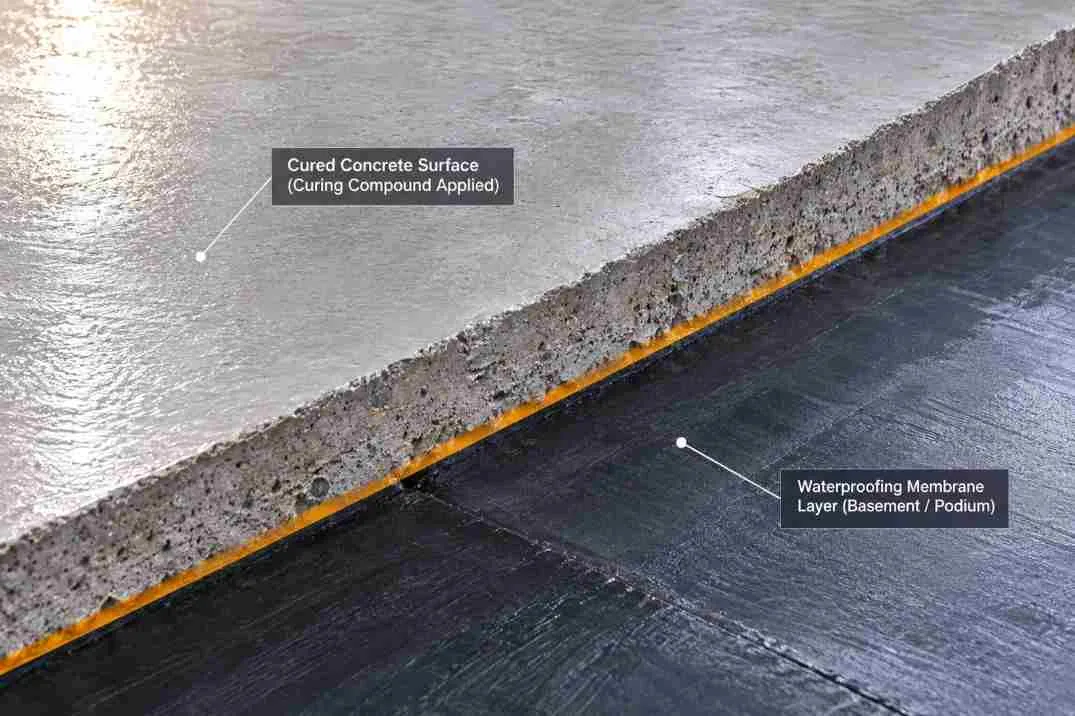
Waterproofing addresses a different failure point entirely: water getting into the structure after it has already cured. Basements below the water table, roof slabs exposed to seasonal rain, and podium decks over parking levels are the usual trouble spots across Dubai and Sharjah developments. A waterproofing system creates a barrier, either integral to the concrete or applied as a membrane, that stops moisture migration before it reaches rebar or interior finishes.
This matters because water damage in the UAE rarely announces itself early. Salt-laden groundwater can sit against a poorly protected foundation for months before staining or spalling becomes visible on the surface, by which point the reinforcement underneath may already be compromised. Renovation projects that skip a proper waterproofing assessment tend to repeat the same failure within a few years.
Curing Compounds and Why the Gulf Climate Changes the Calculation
Curing is about controlling moisture loss in the first days after a pour, not decades later. Fresh concrete needs sustained hydration to reach its design strength, and in a climate where surface temperatures on an unshaded slab can exceed ambient air temperature significantly, water evaporates from the top layer far faster than standard curing schedules assume in temperate regions.
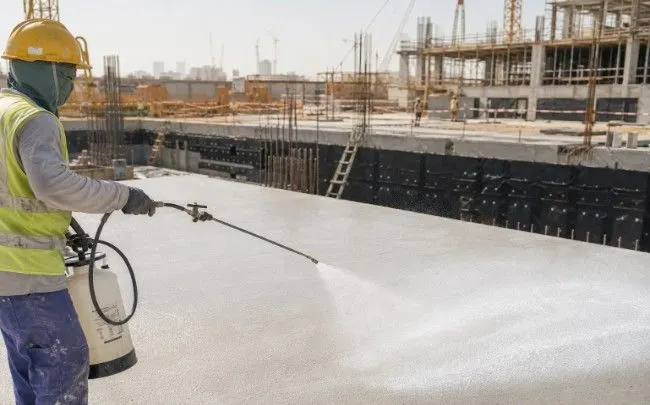
A curing compound is sprayed onto the fresh surface to form a film that slows that evaporation, giving the concrete time to hydrate properly instead of drying out and shrinking unevenly. Skip this step, or apply it late, and the result is often visible: surface cracking, a chalky top layer, and reduced strength exactly where the slab needs it most, at the wearing surface.
Choosing Between the Two for a Given Project
These two product categories are not interchangeable, and a project usually needs both at different stages rather than one instead of the other. The curing compound goes on immediately after finishing, while the concrete is still green. Waterproofing gets specified based on where the structure sits relative to groundwater, rainfall exposure, or future water contact and is planned during design rather than added as a fix after complaints start.
Construction chemicals range gives a sense of how admixtures, waterproofing systems, and surface treatments fit together as a single product family rather than separate purchases. For technical thresholds on chloride exposure and reinforcement protection, American Concrete Institute (ACI) guidance on concrete durability is a useful reference point for engineers specifying mix design in coastal or high-salinity conditions.
Final Thoughts
Getting waterproofing and curing right is less about picking a premium product and more about matching the right chemistry to the right stage of the pour. A project engineer who treats these as sequential decisions, curing first and waterproofing planned into the design, tends to avoid the repeat repairs that eat into budgets two or three years down the line. What does your current specification process look like for these two stages, and where does it tend to break down?
FAQ
Curing compound works in the first few days after a pour, keeping moisture in so the concrete hardens properly. Waterproofing is a longer-term barrier against water getting into the finished structure. One protects the curing process; the other protects the building for years afterward.
Often yes. Admixtures can reduce permeability and improve durability, but they rarely replace a dedicated waterproofing system for basements, roofs, or podium decks. Think of admixtures as improving the concrete itself and waterproofing as a separate line of defense at vulnerable points.
Heat and low humidity pull water out of fresh concrete fast. Without a curing compound holding that moisture in, the surface can dry and shrink unevenly within hours, long before the concrete has reached useful strength. UAE site conditions leave far less margin for error than milder climates.
No. Curing happens right after finishing while the slab is still green. Waterproofing is typically specified during design and applied at a later, defined stage, sometimes as part of the concrete mix and sometimes as a separate membrane. Trying to combine the timing usually compromises one or both.
Surface cracking, a weak or chalky top layer, and reduced long-term strength are the most common results. These issues are frequently invisible until months later, when they show up as spalling, staining, or reinforcement corrosion that costs far more to fix than the curing step would have.